.png?w=1555&h=1555)
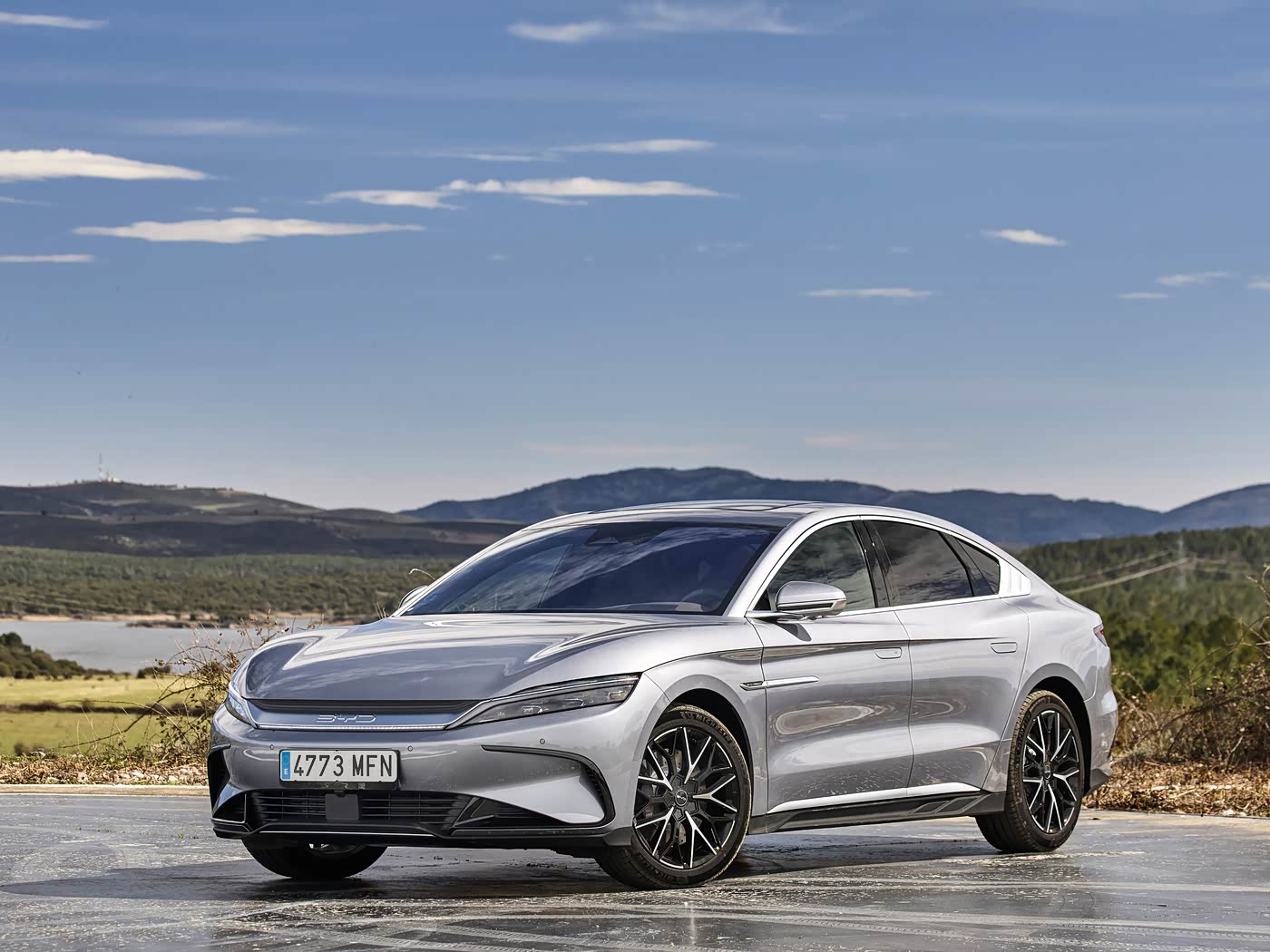
[Autohome Industry News] This week's hot topic: BYD sues the U.S. government, launching a legal challenge against tariff executive orders. Progress has already been made after a liquor importer's lawsuit last year. Mercedes-Benz dealers in China are under pressure, with the dealer council urging the brand to take urgent action; Mercedes-Benz responded to the council's demands, lowering prices by 10% for some models. Traditional automakers have successively released their 2025 performance forecasts, showing "sharply diverging performance." SAIC Motor emerged from its slump with a performance rebound; Great Wall Motors saw revenue growth without profit growth; BAIC BluePark's losses narrowed significantly.
Overseas, Toyota sold 11.32 million vehicles in 2025, topping the global sales charts for the sixth consecutive year. While automakers transitioning to new energy face challenges, Toyota has benefited.
In the supply chain, CATL intensively signed agreements to build factories, marking a new cycle of battery industry capacity expansion.
1. BYD Sues U.S. Government, Mounts Legal Challenge Against Tariff Executive Orders
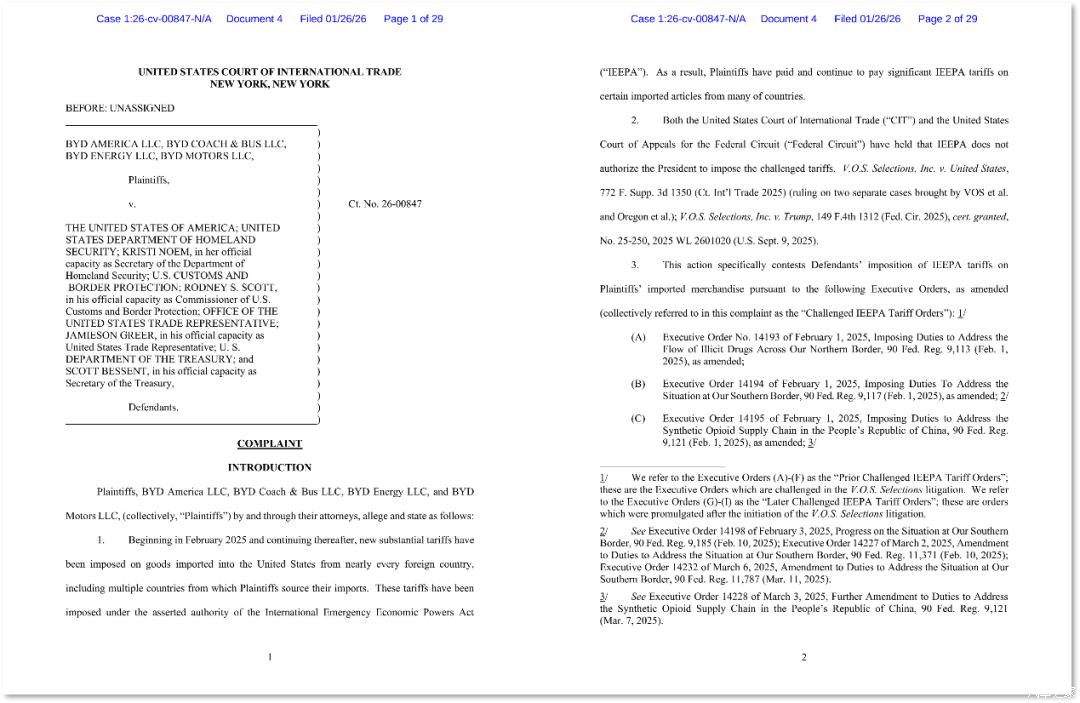
On January 26, 2026, four U.S. affiliates of BYD (BYD) formally filed a lawsuit in the U.S. Court of International Trade (CIT), mounting a legal challenge against a series of tariff executive orders implemented by the U.S. federal government under the International Emergency Economic Powers Act (IEEPA). The CIT disclosed this lawsuit information on February 2.
BYD has not yet responded.
The case has been officially docketed under Case No. 26-00847.
According to the full text of the complaint obtained by Caijing, the plaintiffs in this case are four of BYD's core operating entities in North America: BYD America LLC, responsible for North American distribution and services; BYD Coach & Bus LLC, responsible for manufacturing electric commercial vehicles; BYD Energy LLC, responsible for battery business; and BYD Motors LLC, responsible for import sales.
The defendants are the U.S. federal government and key officials from the Department of Homeland Security (DHS), Customs and Border Protection (CBP), the Office of the U.S. Trade Representative (USTR), and the Department of the Treasury.
The lawsuit concerns nine executive orders and their amendments issued by the U.S. government since February 2025. These include border tariffs targeting Mexico (No. 14194) and Canada (No. 14193); a series of tariffs targeting China, covering Fentanyl (No. 14195), "Reciprocal Tariffs" (No. 14257), and subsequent retaliatory tariff increases (No. 14266); as well as specific country-specific tariff orders targeting Brazil (No. 14323) and targeting India concerning Russian oil transactions (No. 14329).
BYD requests the court to rule that the defendants lack the statutory authority to impose tariffs under the IEEPA framework and that such actions constitute overreach. BYD asserts that all challenged tariff executive orders are ultra vires and should be declared invalid. The court should strip the defendants of their power to implement or collect tariffs based on these orders and issue a permanent injunction prohibiting them from continuing to enforce the related measures.
Regarding economic relief, BYD requests the court to order the U.S. government to refund all IEEPA tariffs collected from the plaintiffs, pay interest as required by law, and award the plaintiffs reasonable litigation costs.
BYD's lawsuit is part of a current wave of large-scale litigation in the field of U.S. trade law. Since 2025, thousands of importers have filed similar lawsuits in the CIT, jointly challenging the legality of the executive branch's use of IEEPA to impose tariffs.
Progress has been made in a 2025 lawsuit by a U.S. liquor importer challenging the legality of U.S. government tariffs. Among this series of cases, the earliest lawsuit, V.O.S. Selections v. United States (referred to as the "V.O.S. case"), holds a central position. Initiated in April 2025 by V.O.S., a New York-based liquor importer with only about 20 employees, the case has achieved preliminary judicial progress. Both the CIT and the Court of Appeals for the Federal Circuit ruled in favor of the plaintiff, holding that the President lacks the authority to impose tariffs under IEEPA.
Currently, the U.S. government has appealed to the U.S. Supreme Court (SCOTUS). SCOTUS completed oral arguments on November 5, 2025, and a final ruling is expected in the first half of 2026.
The CIT has issued a "stay order" for thousands of similar nationwide cases, including BYD's. Given that SCOTUS is about to issue a final, universally binding ruling on IEEPA tariff authority, and to avoid wasting judicial resources due to inconsistent judgments, the CIT has currently issued a "stay order" for thousands of similar nationwide cases, including BYD's. All similar cases are procedurally frozen, pending the Supreme Court's final ruling on the V.O.S. case.
Despite the Supreme Court not having issued a final ruling, BYD's lawsuit at this time still holds necessary procedural value. On one hand, some import entries have begun or are about to undergo customs clearance. If they do not file suit promptly, companies risk losing their right to recourse. On the other hand, BYD's lawsuit scope not only covers the tariff executive orders involved in the V.O.S. case but also supplements those issued after the V.O.S. case targeting countries like Brazil and India.
BYD's business layout in the U.S. market is mainly focused on commercial vehicles and energy infrastructure. As early as 2013, BYD established a manufacturing plant in Lancaster, California, which is one of the largest electric bus factories in North America, with an annual capacity of about 1,500 units and employing over 750 local union workers.
Currently, BYD's main businesses in the U.S. are electric buses and energy storage systems, providing products for municipal public transit systems and utility projects across the country. Its North American business has an annual revenue scale of approximately $5 to $10 billion. Although this does not constitute a prominent share of BYD's overall revenue, North America remains an important window market for showcasing its high-end manufacturing capabilities and enhancing its global brand influence.
If BYD wins the lawsuit, its passenger car business in the U.S. and surrounding countries could see breakthrough opportunities. BYD is currently the only Chinese brand automaker to have entered the pre-approval list under the supervision and review of Canada's Ministry of Transport, poised to be the quickest beneficiary of this policy.
In 2025, Mexico became BYD's largest single overseas market, with cumulative exports exceeding 120,000 vehicles for the year.
In January 2026, during his visit to China, Canadian Prime Minister Carney reached a preliminary trade agreement to import Chinese electric vehicles. Canada plans to import 49,000 Chinese electric vehicles in 2026, subject to a Most Favored Nation tariff rate of 6.1%, with annual quota increases thereafter, expected to reach 70,000 by 2030.
Brief Comment:
BYD's hot sales in Mexico and the impending spillover effect from its entry into Canada will directly impact U.S. consumers. If BYD wins the lawsuit, products from its Brazil plant could enter the U.S. market with a tariff rate lower than 15%; the previously shelved Mexico factory project would also see the removal of its main policy uncertainty, making conditions more favorable for restarting and advancing it.